The wrong color for Earth; the wrong number of fingers for Milotis
The People UpstairsThe expression "The wrong color for Earth; the wrong number of fingers for Milotis" names the double exclusion at the heart of the Greenes’ existence. Dan Greene’s body is visibly green and his pupils are red when his disguise is removed, while his hands have been altered so that they are suited to more than five fingers. On Earth, his natural coloring is impossible to present openly; on Milotis, his adapted hands mark him as no longer fully native. The phrase therefore describes not merely an unusual anatomy but an identity trapped between two worlds.
Literal Meaning and Physical Difference
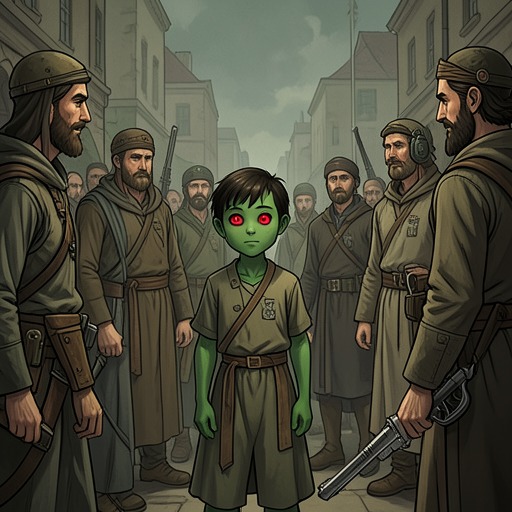
The first half of the expression refers to the mismatch between Milotan biology and Earthly expectations. Dan Greene has a dull light-green face and restrained maroon-red pupils, features that are ordinary on Milotis but unacceptable as an unmasked human appearance. May Greene likewise removes a silk-thin plastomask and Milotan contact lenses when she reaches the privacy of the apartment. In public, the couple must maintain the visual signs of an Earthly middle-aged household; in private, their bodies expose the alien reality that the apartment’s conventional furniture is meant to conceal.
The second half reverses the direction of estrangement. Dan’s hands are wide and constructed to support more than five fingers, making them biologically appropriate to Milotan life but physically wrong by Earth standards. Yet the very adaptations that help the Greenes function on Earth have also damaged their prospects at home. Their assignment was intended to last a lifetime, and the alterations included amputations. The agents have thus been made into monstrosities on Milotis just as their natural bodies would appear monstrous on Earth.
The Expression as a Migrant Paradox
The phrase becomes especially powerful when May announces that she is going to have a baby. The pregnancy is unexpected because the Bureau sends women to Earth who are believed to be sterile or past childbearing age. May and Dan initially understand the pregnancy as a professional disgrace that may force them back to Milotis. The Bureau would blame them for failing to take proper precautions, while returning home would expose a more difficult truth: after years of adaptation, they could no longer simply resume their former lives there.
May explains that they will not be reassigned to another Earth post and that living at home will be difficult because they cannot adapt themselves back. Their bodies have been permanently organized around the place where they serve. The expression consequently defines a condition of irreversible displacement: Earth rejects the signs of their original biology, while Milotis has become inaccessible through the changes imposed for Earthly concealment. Neither world is a secure bodily home.
Disguise, Domesticity, and Exposure
The Greenes manage this contradiction through a strict division between public performance and private knowledge. Mrs. Gottesmann encounters Mrs. Greene in the self-service elevator and sees only a tired, conventionally presented neighbor. At home, however, May removes the plastomask and contact lenses, and Dan speaks to her in a language that is not English. Their apartment is filled with department-store modern furniture in brown monotones and tweedy textures, yet the banality is only a surface. Beneath it lies an emotional impression of alienness that ordinary visitors do not consciously recognize.
This system of concealment depends on other people’s assumptions as much as on the devices themselves. The neighbors gossip about the Greenes, and Old Mrs. Danko mutters about the evil eye and possibly calls Terence Greene a changeling. Such suspicions approach the truth without reaching it. The household’s strangeness is repeatedly translated into familiar human explanations rather than recognized as evidence of extraterrestrial life. The expression captures this unstable success: the disguise works, but it never removes the underlying bodily difference.
Terence and the Inheritance of Difference
Terence Greene inherits the consequences of the phrase in a new form. Dr. Robinson alters him so thoroughly that he has no practical future except to follow his parents’ path, and rejection by the government of Milotis would leave him lost. May and Dan therefore raise him in the Earthly environment while preserving his Milotan inheritance. They speak both Milotan and English at home, warn him not to use Milotan in public, and keep him away from other children whenever possible.
His enrollment in human school makes the conflict institutional rather than merely domestic. May presents the Greenes as Christian Scientists so that Terence will not be subjected to medical examinations, relying on the school’s willingness to accommodate a well-paying family. The strategy protects him temporarily, but it also leaves him without an honest framework for understanding his body. He is told that he is different, yet not given the full meaning of that difference.
The crisis arrives through swimming lessons. Terence realizes that his body cannot remain hidden when school requires children to appear unclothed or nearly so. He tells May that he is different, and the statement functions as an accusation: his alien condition is not only a private fact but something he experiences as his parents’ responsibility. The principal then calls him a freak and assumes that his appearance proves rumors about radiation fallout and concealed mutations. Human prejudice does not discover the truth; it converts the visible anomaly into a story that its own culture already knows how to believe.
Thematic Significance
As an expression, "The wrong color for Earth; the wrong number of fingers for Milotis" joins body, geography, and political identity. Color and fingers are concrete signs, but their wrongness is relational rather than absolute. Dan’s green skin is not intrinsically defective, and his hands are not intrinsically malformed; each becomes wrong when measured against the standards of the other world. The phrase therefore exposes the arbitrariness of normality while showing how power makes that arbitrariness consequential through disguise, medical scrutiny, schooling, and bureaucratic judgment.
It also gives the story its governing irony. The Greenes’ careful adaptations allow them to pass as ordinary Earth residents, yet the same adaptations prevent a simple return to Milotis. Their child is born into the promise of belonging on Earth but carries a concealed origin that makes ordinary human institutions dangerous. The expression’s two balanced clauses preserve that unresolved symmetry: wherever the Greenes stand, some part of their body testifies that they belong elsewhere.